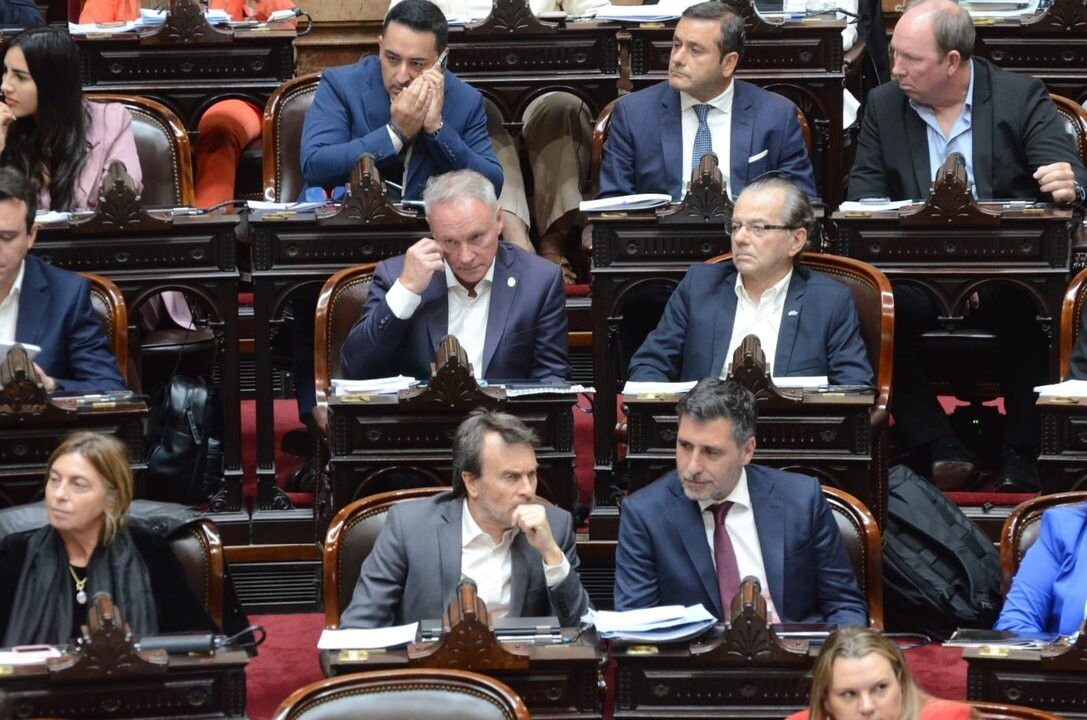
Buenos Aires, December 17 (NA).- The sanction of the “Fiscal and Monetary Commitment and Stability” bill is at risk and could be postponed due to questioning from opposition lawmakers and even allies, according to legislative sources who spoke to the Argentine News Agency.
The bill, which received a committee report, prohibits the passage of laws that do not have guaranteed funding and establishes penalties of up to six years in prison for officials who apply those norms.
The initiative was flatly rejected by opposition members of Unión por la Patria, the left, and Provincias Unidas, and was questioned by allies of PRO and UCR.
In this context, parliamentary sources told NA that it is likely that the bill will fail due to lack of quorum, as it is listed last on the agenda, or that a group of lawmakers will request that it be returned to committee.
Radical Deputy Lisandro Nieri said that “there is a conviction of a monetary and fiscal order. It is clear that we must leave that in writing, and that is what the Fiscal and Monetary Commitment Law seeks to do,” but noted that it must be “worked on with more seriousness.”
“ That law is important, but I aspire for us to give ourselves more time to work on this case,” he added.
For her part, Deputy Karina Banfi stated that the Fiscal Commitment bill “does not respect the basic principles of the separation of powers. It delegates powers to the Executive Branch that are proper to Congress and creates criminal types that do not withstand a constitutionality analysis, among many other legal-technical errors.”
Yesterday, the president of the UxP bloc, Germán Martínez, had demanded that this initiative also be analyzed in the Penal Legislation Committee since it includes modifications to the penal code.
DETAILS
The bill establishes that “the passage of a general budget law that contemplates a deficitary financial result is prohibited.”
One of the most outstanding data points of the bill is the severe sanctions it applies to national officials. In this sense, the bill provides for a penalty of one to six years in prison for the official who violates the norms established in the National Commitment Law for Fiscal and Monetary Stability.
Throughout the bill, it enables the Chief of Cabinet to use an adjustment mechanism to avoid putting the fiscal balance at risk. In this regard, it states that “if during the execution of the budget there is a decrease in the projected resources or an increase in expenses above the original estimates that puts at risk the fulfillment of the rule established in article 1°, the Chief of Ministers of Cabinet will adopt the necessary measures to restore said balance.”
Furthermore, the initiative establishes that any law that “authorizes expenditures not contemplated in the general budget will begin to apply once the corresponding items are expressly included in the general budget law for the fiscal year following its sanction.”
It determines that laws that ensure funding “through the allocation of concrete, specific, current, and sufficient resources, without affecting the balanced financial result” will be exempt from that obligation.
It also establishes that all bills, prior to their consideration in committee, must have a medium-term budget impact report, which will be prepared in the case of government initiatives by the Ministry of Economy and in the case of legislative initiatives by the Congressional Budget Office.
Another point is that it establishes that any norm enacted in violation of the provisions of this law will be declared null and void.